What does a multiply cost?
Part 10 of the RISC-V soft core series. Previously: First C on the core.
The first C program had a line in it that looks harmless: a * b. On a modern laptop that is one instruction and a few clock cycles. On this core there is no instruction for it. The core is RV32E with no M extension, so no mul, no div and no rem. The compiler turns each *, / and % into a call to a library routine, a loop of shifts and adds that runs as ordinary code.
How much does that cost? I did not want to guess, and I realised I did not have to, because the core has the thing needed to measure it.
A clock the program can read
I wondered whether the program could print its own cost, in our time, real time. Of course, we have real time, mtime is a free running counter in the memory map, and a read-only word beside it says how many clocks make a tick.
So the program can time itself. The recipe in cost.c:
- call the operation sixteen times, through a function pointer and
noinlinewrappers, withvolatileoperands, so the compiler cannot fold anything away or optimise the calls out, - time the same loop around a function that just returns its first argument, and subtract it, so the loop, the call and the operand loads cancel,
- print
(ticks * clocks per tick) / 16: clocks per call.
The operands are picked for how the library loops behave. The multiplier has 3, 16 and 32 bits. The quotient has 4, 17 and 32.
The table
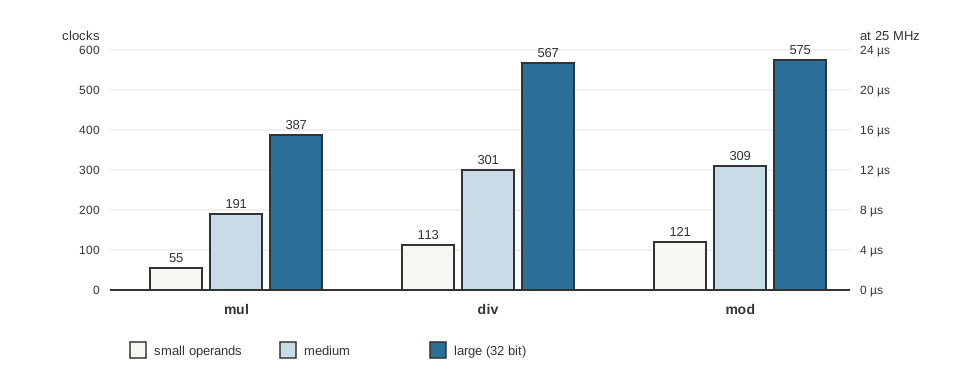
Clocks for one call, wrapper included. The right hand axis is microseconds if the clock is 25 MHz, which is what the build is made for.
| Operation | Small | Medium | Large |
|---|---|---|---|
mul |
55 | 191 | 387 |
div |
113 | 301 | 567 |
mod |
121 | 309 | 575 |
At 25 MHz that is about 2 microseconds for a small multiply and about 23 microseconds for a remainder of a full 32 bit number. The same table appears in the simulator’s window, to within a clock or so, because the simulator’s tick is five clocks and it averages over sixteen calls.
What the numbers say
The cost is not a fixed number. It grows with the size of the operands: roughly ten to twelve clocks per bit of the multiplier, and seventeen to nineteen per bit of the quotient. A multiply by a small constant is cheap. A 32 by 32 multiply is not. A remainder is about the same as a divide, which fits: it is the other half of the same division.
That is the argument for or against a hardware multiplier, in numbers:
- A multi cycle multiplier, one step per bit, would be about 32 clocks flat. The large case would drop from 387 to roughly a tenth.
- A step that handles two bits at a time would halve that again.
- It costs logic. The core is already about two thirds of the chip. I have not decided, and these numbers are how I will.
For a program that multiplies rarely, or by small numbers, the library is fine. For a program that does a lot of arithmetic on full size values, it is the first thing I would change.
Two wrong turns in the measurement
Printing the operands cost more than the operations. My first version printed the operands in decimal. The model ran 44,927 instructions and then the test generator refused it: “no halt after 20000 instructions.”
The reason is that printing a ten digit number in decimal is a stack of divides and remainders, one pair for every digit, and each one costs up to about 570 clocks. I was spending more time printing what I was measuring than measuring it. The operands now print in hex, which is shifts and no divides. It dropped the whole run to about 31,000 instructions and 66,000 clocks.
The program restarted at clock 65,536. In the Yosys simulation the run went wrong halfway and then started again from the beginning. It was not the core. A harness counter that tells the reset when to end was sixteen bits wide, so when the count reached 2 to the power 16 it wrapped to 0 and the harness reset the core again. I found it by tracing the program counter: the last values before the restart were ordinary library loop code, and the restart landed at exactly that round number. No earlier test had run 65,000 clocks. I widened it to 32 bits, and the generated testbench had the same fault in a counter that only drives scheduled button presses, where nothing had gone wrong.
There was a third, smaller one: the run length was sized as three times the serial time plus a thousand clocks, which suits a program that mostly prints. This one spends sixty thousand clocks computing.
The test that the Alchitry simulator could not run
I wrote a testbench for the program, too. It took thirteen minutes in the Alchitry simulator and failed on both full runs with the first byte wrong. I shortened it and instrumented it. Three more runs: two passed through byte 60, and one failed with a character received twice.
I could not reproduce the first failure, and I did not chase it. Yosys runs the same program on the same Verilog and passes every time, with the same bytes and the same cycle counts. And the simulator thread has explained why the Alchitry simulator is a sample. The test is too slow to belong in the suite anyway, so it runs under Yosys only.
The mutation that matters for the measurement: make mtime count by 2, and every figure doubles and the test fails. So the table is tied to the timer.
What I learned
The cost of a feature is a number, and you can have the number. The core already had a clock that counted real time. Once the program could read it, the machine could report on itself, and the argument for a hardware multiplier stopped being a feeling.
And the biggest cost in the first draft was my own printing. The thing being measured was not where the time went.
Next time, what I found when I went looking for the edges: where it breaks.